10 Things Research Says About Strength Training After 40
Strength training after 40 comes with plenty of advice.
Lift heavy because you’re losing muscle. Train more because age is catching up. Stick to machines. Avoid machines. Two sessions a week is enough. Four is better.
I wanted to know what the research actually supports once you move past the usual gym advice.
This review draws on systematic reviews, meta-analyses and randomized trials covering strength, muscle mass, physical function, training frequency, bone health, metabolic health and longevity.
Some of those reviews include more than a hundred individual trials. There is one limitation worth knowing from the start: much of the strongest evidence comes from adults in their 60s, 70s and even 80s rather than specifically from healthy men aged 40 to 59.
Even with that limitation, several findings appear consistently enough to be useful.
1. Getting Stronger Is Where the Evidence Is Strongest
Resistance training reliably improves strength in older adults.
A 2020 systematic review of 22 randomized trials looked at very old adults, including people in their late 70s and 80s. Strength improved substantially. Muscle size improved too, although the changes were smaller.
That difference between strength and muscle size appears repeatedly in the research.
You can get meaningfully stronger without looking dramatically more muscular.
Part of that comes from your nervous system getting better at recruiting the muscle you already have. Some muscle growth usually occurs too, but strength tends to improve more consistently.
That is worth remembering if you’ve started lifting and keep checking the mirror for proof that it’s working.
A large 2024 network meta-analysis combined 151 randomized trials involving 6,306 older adults. Resistance training improved lower-body strength along with physical function, lean body mass and muscle growth.
For everyday life, strength matters in fairly ordinary ways.
Getting out of a low chair. Carrying luggage. Moving furniture. Climbing stairs. Lifting something from the floor without turning it into a major effort.
Those things may eventually matter more than the numbers in your workout log.
2. You Can Still Build Muscle as You Get Older
Age-related muscle loss is real.
That sometimes gets turned into a much more dramatic message: once you’re past 40 or 50, building muscle becomes extremely difficult.
The research does not support that conclusion.
Reviews involving older adults, including people with sarcopenia, show that resistance training can increase muscle size. The gains are usually modest and results vary depending on the population and how muscle mass is measured.
Strength tends to improve more reliably than visible muscle mass.
If your goal is to maintain enough muscle to stay capable as you age, you do not need bodybuilding-level growth for your training to be worthwhile.
Progress may also look different from what it did when you were younger. Training history, recovery, sleep, nutrition and health can all influence how quickly you adapt.
If you’ve spent years doing mostly cardio, resistance work can add something your previous training was missing. I wrote about that separately in I Did Only Cardio for a Year After 40. Then I Added Weights.
3. Two or Three Sessions a Week Is a Sensible Range
One practical question comes up constantly: how often do you actually need to lift?
Across the reviews, many successful programs fall around two to three resistance-training sessions per week.
Some analyses favour three sessions for particular outcomes. Others find twice weekly enough to improve strength and physical function.
That also fits with major physical activity guidelines, which generally recommend strengthening the major muscle groups at least twice each week.
It makes strength training easier to fit into a normal life too.
Two full-body sessions could be Monday and Thursday, Tuesday and Friday or whatever works around the rest of your week. The exact days matter much less than whether you keep doing them.
Frequency becomes more important if you’re trying to maximise muscle or strength.
For general health, maintaining muscle and staying physically capable, the research gives you quite a bit of flexibility.
I cover that question more fully in How Often Should Men Over 40 Strength Train?.
4. Heavier Resistance Can Build More Strength, but “Heavy” Is Relative
Higher-intensity resistance training generally produces larger improvements in maximal strength than lighter training.
A 2026 meta-analysis involving adults over 50 found that training at 70% or more of one-repetition maximum produced greater gains in measures such as leg press and leg extension strength than lower-intensity training.
The included studies did not find a significant difference in safety between the higher and lower intensity groups.
That percentage sounds more technical than it needs to.
Your one-repetition maximum, usually shortened to 1RM, is simply the heaviest weight you could lift once with good technique.
You do not need to test it.
For many people, a weight that makes roughly 8 to 12 controlled repetitions genuinely challenging already provides meaningful resistance.
And heavy is relative.
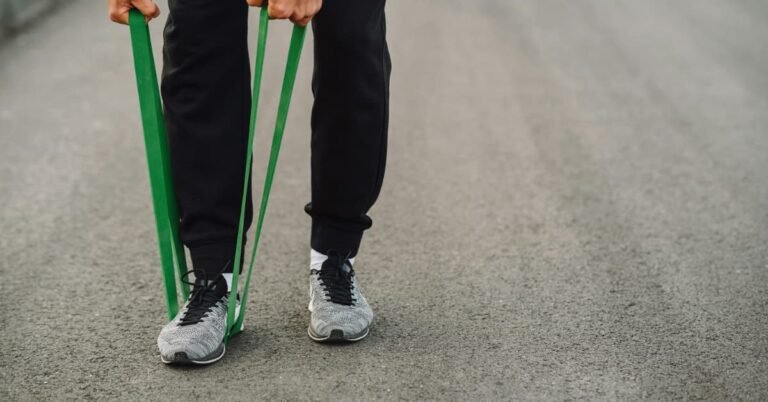
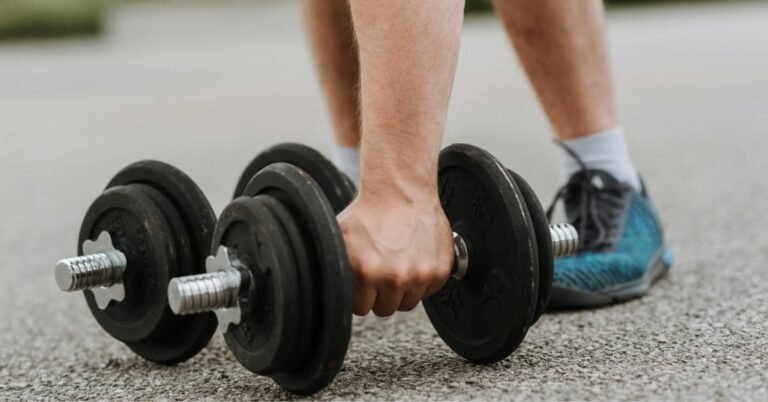
If you’re restarting after years without strength training, a fairly light dumbbell or resistance band may be challenging enough at first.
The useful part is progression.
Once the same exercise becomes noticeably easier, something eventually needs to become harder if you want to continue improving.
5. More Sets Do Not Automatically Mean Better Results
This is one of the more useful findings if long workouts put you off strength training.
The 151-trial network meta-analysis found that lower-volume training performed particularly well for physical function, lean body mass and muscle growth. Moderate-to-high training volumes tended to work better when the goal was maximising lower-body strength.
Another systematic review looked at single-set versus multiple-set training in adults aged 50 and older.
Multiple sets produced a small advantage for some lower-body strength outcomes, but there was no clear advantage across every measure of muscle size or functional capacity.
That gives you some room to decide what you’re actually training for.
If you enjoy longer sessions and want to push your strength or muscle further, extra volume may help.
If you’re mainly trying to stay strong, healthy and capable, you may need less training than you think.
A shorter routine that stays in your week for years has an obvious advantage over a more ambitious one you stop doing after a month.
6. Strength Training Improves Things You Notice Outside the Gym
Researchers do not only measure how much weight people can lift.
Studies also look at practical measures such as getting up from a chair, walking ability and timed movement tests.
Resistance training improves many of these outcomes, particularly in older adults.
That includes healthy people as well as adults who are frail or have sarcopenia.
One study is especially interesting because it followed people for much longer than the usual 8- or 12-week training period.
Adults around retirement age were assigned to heavy resistance training, moderate training or usual activity. The training period lasted one year.
Several years later, the group that had completed heavy resistance training had preserved its leg strength better than the moderate-training and control groups.
The 2024 follow-up does not mean one year of lifting protects you forever.
It does suggest that building strength before substantial age-related decline sets in may leave you with more physical reserve later.
7. The Benefits Extend Beyond Muscle
Skeletal muscle also plays an important role in glucose regulation.
A 2025 meta-analysis included 43 randomized trials and 2,012 middle-aged and older adults with type 2 diabetes.
Resistance training improved insulin resistance, blood glucose control, muscle mass and strength. The pooled reduction in HbA1c was around 0.55 percentage points.
Those participants already had type 2 diabetes, so you should not assume the same effect in every healthy adult over 40.
The findings do reinforce the idea that resistance training affects more than muscle and appearance.
Muscle is one of the tissues involved in taking glucose from the bloodstream.
Walking and other aerobic exercise matter too. Strength training adds a different type of stimulus rather than replacing them.
8. Bone Health Can Improve, but Usually Modestly
Strength training is often recommended for bone health.
There is evidence behind that, although the effect is less dramatic than some claims suggest.
A 2022 systematic review of 14 randomized trials involving 1,130 older adults found clear improvements in strength alongside modest improvements in bone mineral density around the hip and femur.
Results at the lumbar spine were less consistent.
The studies also varied quite a lot, which makes exact predictions difficult.
Resistance training can therefore be part of a bone-health strategy, but the research does not support treating it as a guaranteed way to reverse osteoporosis or significant bone loss.
If you already have osteoporosis, your exercise selection and loading may need individual guidance.
9. Resistance Training Is Linked With Longer Life, but That Does Not Prove Cause and Effect
The longevity research is encouraging.
It is also where careful wording matters most.
A 2022 systematic review and meta-analysis by Momma and colleagues found that muscle-strengthening activity was associated with roughly 10% to 17% lower risks across outcomes including all-cause mortality, cardiovascular disease, cancer and diabetes.
Another 2022 meta-analysis by Shailendra and colleagues found that people who reported resistance training had around 15% lower all-cause mortality, 19% lower cardiovascular mortality and 14% lower cancer mortality than people reporting none.
Both analyses found meaningful associations at fairly modest amounts of weekly resistance training.
The largest observed reductions in all-cause mortality appeared somewhere around 30 to 60 minutes per week.
That does not make 30 or 60 minutes a proven longevity prescription.
These were observational studies. People who strength train may also eat differently, smoke less, exercise in other ways or differ in their overall health.
The careful conclusion is that resistance training is consistently associated with better long-term health outcomes.
The research cannot tell you that adding exactly one hour of lifting to your week will reduce your mortality risk by a specific percentage.
10. Safety Looks Reassuring, With Some Uncertainty
Resistance training was generally well tolerated across studies involving older adults.
Reviews involving very old adults reported relatively few serious problems, although adverse events were not always recorded consistently.
Studies comparing higher and lower training intensity also did not find clear differences in safety.
One 24-week randomized trial reported more than 90% adherence without training-related adverse effects.
That is reassuring, but there is some context worth keeping in mind.
Many of these studies involved supervised programs. Some were also fairly short.
Technique, exercise selection and gradual progression still matter, particularly if you’re returning after a long break.
If that describes you, How to Avoid Injury Starting Strength Training After 40 covers the practical side in more detail.
What the Research Looks Like at a Glance
| Question | What the research suggests |
| Can you still get stronger as you age? | Yes. This is one of the most consistent findings |
| Can older adults build muscle? | Yes, although muscle gains are generally more modest than strength gains |
| Is twice a week enough? | Often, yes. Many successful programs use 2-3 sessions per week |
| Do heavier weights work better? | Generally for maximal strength, provided the training is appropriate |
| Do you need lots of sets? | No. Lower volumes can work well for muscle, function and general health |
| Does strength training improve everyday function? | Good evidence, particularly in older adults |
| Does it help metabolic health? | Good evidence, especially in adults with type 2 diabetes |
| Does it increase bone density? | Modest improvements at some bone sites |
| Does it help you live longer? | It is associated with lower mortality, but causation has not been established |
| Is it safe after 40? | Generally reassuring when training is appropriate and progression is sensible |
One thing I took away from the research is how ordinary a useful strength routine can look.
You do not need to train like a competitive lifter.
You can use machines because you like them. You can train with dumbbells at home because getting to a gym is inconvenient. Resistance bands can work too.
You also do not need to squeeze every possible result out of every session.
For many men over 40, two or three manageable sessions each week, gradually made a little harder over time, already line up remarkably well with what the research supports.
For the broader picture on exercise selection, progression and recovery, read the Complete Guide to Strength Training After 40.
Frequently Asked Questions
Is it too late to start strength training at 40 or 50?
No. Research involving adults much older than 50 consistently shows that strength and muscle can still improve with resistance training.
How many days a week should I strength train after 40?
Two to three sessions per week is a common range in successful studies. Two well-planned full-body sessions can be enough for general health and strength.
Do I need to lift heavy weights?
You do not need maximal weights. Higher resistance tends to produce greater maximal strength gains, while moderate resistance can also work when the exercise is sufficiently challenging.
Can strength training slow muscle loss?
Resistance training can help maintain and increase muscle as you age. Strength improvements tend to be larger and more consistent than increases in muscle size.
Is strength training better than walking after 40?
They provide different benefits. Walking strongly supports aerobic health and daily movement while resistance training is especially useful for muscle, strength and physical function. Most adults benefit from including both.
Research Used for This Review
- Grgic J et al. Effects of Resistance Training on Muscle Size and Strength in Very Elderly Adults: A Systematic Review and Meta-Analysis of Randomized Controlled Trials. Sports Medicine, 2020.
- Radaelli R et al. Effects of Resistance Training Volume on Physical Function, Lean Body Mass and Lower-Body Muscle Hypertrophy and Strength in Older Adults: A Systematic Review and Network Meta-analysis of 151 Randomised Trials. Sports Medicine, 2024.
- O’Bryan SJ et al. Progressive Resistance Training for Concomitant Increases in Muscle Strength and Bone Mineral Density in Older Adults. Sports Medicine, 2022.
- Marques D et al. Manipulating the Resistance Training Volume in Middle-Aged and Older Adults. Sports Medicine, 2022.
- Momma H et al. Muscle-strengthening activities are associated with lower risk and mortality in major non-communicable diseases: a systematic review and meta-analysis of cohort studies. British Journal of Sports Medicine, 2022.
- Shailendra P et al. Resistance Training and Mortality Risk: A Systematic Review and Meta-Analysis. American Journal of Preventive Medicine, 2022.
- Bloch-Ibenfeldt M et al. Heavy resistance training at retirement age induces 4-year lasting beneficial effects in muscle strength. BMJ Open Sport & Exercise Medicine, 2024.
- Sun R et al. Effectiveness of resistance training on body composition, muscle strength and biomarker in sarcopenic older adults. Archives of Gerontology and Geriatrics, 2024.
- Wang J et al. Resistance training enhances metabolic and muscular health and reduces systemic inflammation in middle-aged and older adults with type 2 diabetes. Diabetes Research and Clinical Practice, 2025.
- Shen YC et al. Effectiveness of High-Intensity Versus Low-to-Moderate-Intensity Resistance Training in Improving Muscle Strength and Bone Mineral Density in Older Adults. Geriatrics & Gerontology International, 2026.
This article is for general information only. Resistance training can be adapted to many ages and fitness levels, but medical conditions, injuries, osteoporosis and significant joint problems may change what is appropriate for you. Speak with a qualified healthcare or exercise professional if you are unsure about starting or progressing a strength-training program.