Best Bodyweight Exercises for Men Over 40 (No Gym Needed)
You don’t need a gym membership to build strength after 40. You don’t need a rack of dumbbells or a cable machine. You don’t even need a lot of space.
Your own body weight is enough to build and maintain muscle, improve joint stability, support your posture and keep you moving well for years to come. The key is choosing the right movements – ones that work multiple muscle groups at once, are easy on aging joints and can be scaled to your current fitness level.
These are the exercises that matter most for men over 40 who want to train at home with zero equipment.
Why Bodyweight Training Works Well After 40
Before diving into the exercises, it’s worth understanding why bodyweight training is particularly effective at this stage.
After 40, your joints are less forgiving of heavy loads. Cartilage thins, recovery takes longer and the risk of injury increases when you push too hard too fast. Bodyweight exercises naturally limit the load to what your frame can handle, which makes them safer for joints than jumping straight into heavy barbell work.
They also train balance and coordination alongside strength. When you do a bodyweight squat, your stabilizer muscles fire to keep you upright. When you hold a plank, your entire core engages. This kind of functional strength – the ability to move, balance and stabilize under load – matters more after 40 than raw lifting numbers.
And the barrier to entry is as low as it gets. No equipment to buy, no gym to commute to, no waiting for machines. You can train in your living room in 20 minutes. That accessibility is what makes it sustainable long-term.
The Exercises
1. Bodyweight Squat
The squat is the most important lower body exercise you can do. It targets your quadriceps, hamstrings, glutes and core all at once. After 40, squatting regularly keeps your legs strong for everyday activities – climbing stairs, getting off the floor, carrying heavy bags.
How to do it: Stand with feet shoulder-width apart. Push your hips back and bend your knees as if sitting into a chair. Lower until your thighs are roughly parallel to the floor (or as deep as you can comfortably go). Push through your heels to stand back up.
Beginner modification: If balance is an issue, hold onto the back of a sturdy chair or a doorframe as you lower yourself. This gives you confidence without removing the work from your legs.
Sets and reps: 3 sets of 10 to 12 reps. Rest 60 seconds between sets.
2. Push-Up
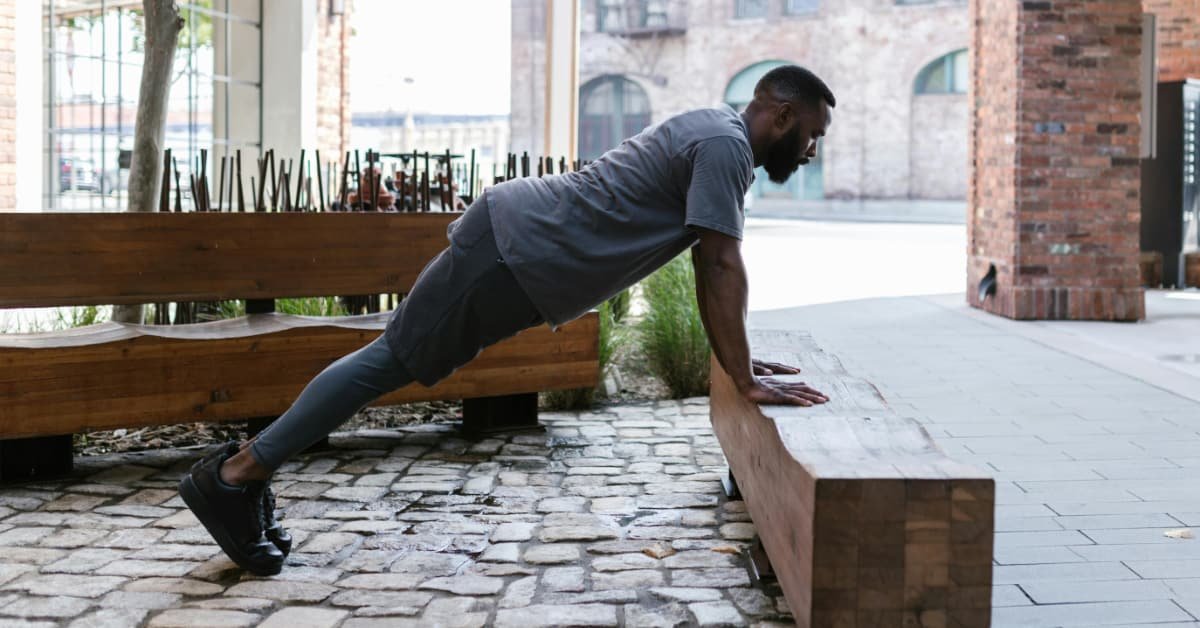
Push-ups build your chest, shoulders, triceps and core. They also support shoulder health and posture – two areas that commonly weaken with age and desk work.
How to do it: Start in a high plank position with hands slightly wider than shoulder-width. Lower your chest toward the floor by bending your elbows. Keep your body in a straight line from head to heels. Push back up to the start.
Beginner modification: Start with your hands on an elevated surface – a kitchen counter, a sturdy table or a wall. The higher the surface, the easier the movement. As you get stronger, gradually lower the surface until you can do full floor push-ups.
Sets and reps: 3 sets of as many as you can do with good form. Even if that’s 3 reps, that counts. Quality over quantity.
3. Glute Bridge
Your glutes are the largest muscle group in your body and one of the most neglected, especially if you sit for long hours. Weak glutes contribute to lower back pain, poor posture and reduced hip mobility – all common complaints after 40.
How to do it: Lie on your back with knees bent and feet flat on the floor, hip-width apart. Push through your heels and squeeze your glutes to lift your hips toward the ceiling. Hold at the top for a second, then lower slowly.
Beginner modification: This exercise is already beginner-friendly. If you want more challenge, try single-leg glute bridges by extending one leg straight while lifting with the other.
Sets and reps: 3 sets of 12 to 15 reps. Focus on squeezing the glutes at the top rather than just lifting the hips.
4. Plank
The plank strengthens your entire core – not just the front abdominal muscles, but the deep stabilizers that protect your spine. A strong core is critical after 40 for preventing back pain, maintaining posture and supporting every other movement you do.
How to do it: Rest on your forearms and toes with your body in a straight line from head to heels. Keep your hips level – don’t let them sag or pike up. Breathe steadily and hold.
Beginner modification: Drop to your knees if a full plank is too demanding. Keep the same straight line from head to knees.
Duration: Hold for 20 to 30 seconds to start. Add 5 seconds each week. Work toward 60 seconds. There’s no benefit in holding planks for several minutes – 60 seconds with good form is plenty.
5. Reverse Lunge
Lunges work your quads, glutes and hamstrings while also challenging your balance. The reverse lunge (stepping backward) is easier on the knees than the forward lunge because it puts less shearing force on the joint.
How to do it: Stand tall with feet together. Step one foot back and lower your back knee toward the floor until both knees form roughly 90-degree angles. Push through your front heel to return to standing. Alternate legs.
Beginner modification: Hold onto a wall or chair for balance. Take a shorter step back if the full range of motion feels too deep.
Sets and reps: 3 sets of 8 to 10 reps per leg.
6. Wall Push-Up or Incline Push-Up (for Shoulders)
This targets your shoulders more than a standard push-up. Shoulder strength is important after 40 for overhead reaching, carrying and general upper body function.
How to do it: Place your hands on a wall at shoulder height, slightly wider than shoulder-width. Step your feet back so your body is at an angle. Bend your elbows to bring your chest toward the wall, then push back. The further your feet are from the wall, the harder it gets.
Progression: As you get stronger, move to a lower surface – counter, then bench, then eventually pike push-ups on the floor for more shoulder emphasis.
Sets and reps: 3 sets of 10 to 12 reps.
7. Dead Hang (if you have access to a bar)
This isn’t strictly bodyweight exercise in the traditional sense, but if you have a pull-up bar, a park bar or even a sturdy door frame, dead hangs are incredibly valuable after 40. They decompress the spine, stretch the shoulders, strengthen grip and improve shoulder mobility.
How to do it: Grab a bar with palms facing away from you. Hang with arms fully extended and feet off the ground. Relax your shoulders and let gravity do the work.
Beginner modification: Keep your feet on the ground and support some of your weight. Even a partial hang provides benefits.
Duration: Start with 15 to 20 seconds. Build to 30 to 45 seconds over a few weeks.
A Simple Weekly Routine
You don’t need to do all seven exercises every day. Here’s a practical schedule that covers everything in three sessions per week:
Day 1 (Lower Body Focus)
- Bodyweight Squats: 3 x 12
- Reverse Lunges: 3 x 10 per leg
- Glute Bridges: 3 x 15
- Plank: 3 x 30 seconds
Day 2 (Upper Body Focus)
- Push-Ups: 3 x max reps with good form
- Wall/Incline Push-Ups for shoulders: 3 x 12
- Dead Hang: 3 x 20 seconds
- Plank: 3 x 30 seconds
Day 3 (Full Body)
- Bodyweight Squats: 2 x 12
- Push-Ups: 2 x max reps
- Reverse Lunges: 2 x 8 per leg
- Glute Bridges: 2 x 12
- Plank: 2 x 30 seconds
Each session takes about 20 to 25 minutes. Rest one day between sessions. On off days, a 30 to 45-minute walk complements this routine perfectly.
Warming Up Isn’t Optional
At 25, you could jump straight into exercise. At 40 and beyond, skipping the warm-up is a direct path to injury.
Spend 5 minutes before each session doing:
- Arm circles (forward and backward, 10 each)
- Bodyweight squats at half depth (10 reps, slowly)
- Hip circles (10 each direction)
- Shoulder rolls (10 forward, 10 backward)
This gets blood flowing to your muscles and synovial fluid moving through your joints. The exercises will feel smoother and your risk of pulling something drops significantly.
Progression Without Equipment
The biggest concern with bodyweight training is that it gets too easy. Once you can do 15 clean push-ups, where do you go without adding weight?
Slow the tempo. Take 3 seconds to lower, pause for 1 second at the bottom, then push up. This dramatically increases the time under tension and makes the same exercise much harder.
Add a pause. Hold the bottom of a squat for 3 seconds before standing up. Hold the top of a glute bridge for 3 seconds. Pauses remove momentum and force your muscles to work harder.
Try single-leg variations. Single-leg squats (holding a chair), single-leg glute bridges and single-leg calf raises all double the load on one leg without adding any equipment.
Increase range of motion. Elevate your feet during push-ups. Go deeper in lunges. Small changes in position create significant differences in difficulty.
You can progress with bodyweight alone for months before you’d ever need to add dumbbells or bands. And when you do, that foundation of control and stability will make weighted exercises safer and more effective.
The Short Version
Bodyweight training after 40 isn’t a compromise. It’s a smart choice. It builds functional strength, protects your joints, requires zero equipment and can be done anywhere in 20 minutes.
The seven exercises in this article – squats, push-ups, glute bridges, planks, reverse lunges, wall push-ups and dead hangs – cover every major muscle group. Done three times a week with a warm-up and gradual progression, they’ll build a foundation that serves you well whether you eventually add weights or stay with bodyweight indefinitely.
Start where you are. Use the beginner modifications without embarrassment. And show up consistently. That’s what builds strength after 40 – not intensity, not equipment, not complicated programs. Just regular movement that your body can sustain.
For the full picture on strength training after 40, read the complete guide.
Frequently Asked Questions
Can you build muscle with bodyweight exercises after 40?
Yes. Bodyweight exercises build and maintain muscle effectively, especially when combined with progressive overload through tempo changes, pauses and single-leg variations.
How many times a week should men over 40 do bodyweight exercises?
Three sessions per week with a rest day between each is enough to see results. Each session takes about 20 to 25 minutes.
What is the best bodyweight exercise for men over 40?
The bodyweight squat is the most important single exercise. It works your legs, glutes and core while supporting everyday movements like climbing stairs and getting off the floor.
This article is for general information only. If you have existing injuries or joint conditions, consult a healthcare professional before starting a new exercise routine.