How Walking Helps Me Manage Stress After 40
I didn’t set out to find a stress management tool. I started walking around 40 because I wanted to feel fitter – nothing more complicated than that. But somewhere in the first few months, I noticed my mood was better after a walk. Not dramatically better. Just… lighter. Clearer.
It took a few weeks of repeated experience before I connected the dots. The tightness in my shoulders that built up through a long workday. The mental noise that followed me from a difficult meeting. The low-grade restlessness that came from juggling work pressure and domestic stuff that never quite gets done. Walking was moving all of that somewhere else – not solving it, but shifting it enough that I could breathe again.
That wasn’t what I signed up for. It turned out to be the thing that kept me going.
What stress actually feels like at this stage
I suspect a lot of men over 40 carry stress the same way I do – without naming it. There’s a physical tightness, usually in the upper back and chest. A busy mind that won’t switch off even when you’re trying to wind down. And then the sleep starts to go. You lie there running through tomorrow’s to-do list, or replaying a conversation from the afternoon, and the next morning you’re already behind.
Work is the main driver for me. But family stuff – the logistical weight of it, the low-level admin of life – adds its own layer. By late evening, if I haven’t moved, I feel a kind of pressure that’s hard to describe. Not quite anxious. Just… compressed.
Walking releases that compression.
What I actually do
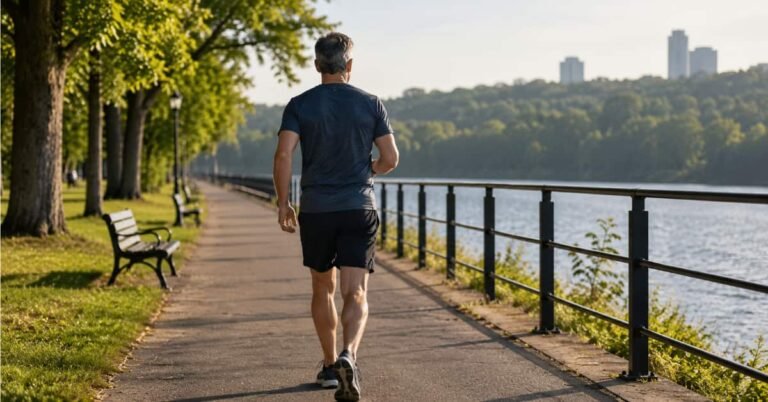
My typical stress-relief walk isn’t a structured fitness session. It’s 30-45 minutes, usually outdoors, and I’m almost always listening to something – a podcast, music, whatever fits the mood. That’s deliberate. When I walk without audio, my mind goes straight back to whatever I was worrying about. Sometimes that’s fine – walking and thinking can actually untangle a problem. But on high-stress days, I need the mental redirect that a podcast gives me.
What I’ve found is that the physical act of walking seems to run parallel to the audio. My body is moving, my ears are occupied, and whatever was sitting heavily in my chest starts to dissolve on its own. I’m not consciously doing anything. The walk does the work.
I don’t overthink the route or the pace. I’m not targeting a heart rate. On days when stress is high, I just get out and move.
The sleep connection with walking
One thing I noticed early on: I slept better on days I walked. Not just marginally better – noticeably better. The kind of sleep where you go under quickly and wake up feeling like you actually rested.
This wasn’t something I read about and then tested. It was the other way around. I noticed the pattern first, then started paying attention to it. Walk days meant better sleep. No-walk days, especially if there was any stress in the mix, meant lying awake longer and waking up less recovered.
There’s a reasonable explanation for this. Walking helps regulate cortisol – the stress hormone that tends to be elevated when you’re under pressure. Physical movement also raises body temperature slightly, and the subsequent cooling is one of the signals your body uses to initiate sleep. I’m not going to oversell the science here, but the effect on my own sleep has been consistent enough that I trust it. If you’re interested in how sleep quality connects to recovery, Why Sleep Feels Different After 40 covers the underlying changes worth understanding.
What happens when I miss days
In the early months, missing two or three days in a row was enough to disrupt my sleep again. And there was a secondary effect I didn’t expect: skipping a walk created its own low-level anxiety. Some of it was tied to breaking a streak on a fitness tracker. But beneath that, I was also aware that I’d lost access to the mood reset walking gave me. The elevated feeling I’d come to rely on just wasn’t there.
I don’t miss walks very often now. The habit is solid. But I still notice the difference on the rare days I skip – there’s a flatness to the evening that I recognise.
You don’t need the full setup
For a long time, I thought walking needed to be done properly. Proper shoes, proper clothes, a route mapped out. That thinking is what stopped me from walking on inconvenient days.
Then I realised something: even moving around the house or along a corridor for 10-15 minutes had an effect. Not the same as a proper 40-minute walk – but noticeably better than sitting still with the same stressed-out mind. The body doesn’t require perfect conditions to get the benefit. It just requires movement.
That shift in thinking changed how I approach difficult days. If I can’t get outside, I move indoors. If I can only do 15 minutes, I do 15 minutes. The bar for “counts” is lower than I thought.
The mood thing is real
I’ve never found a clean way to describe what happens to mood after a walk. It’s not euphoria. It’s not a runner’s high. It’s more like a reset – where the mental noise drops a level or two and the things that felt urgent start to feel manageable again.
For men over 40, that kind of reset matters more than it did in our 30s. The aging and mental health connection is something most of us don’t think about until we’re in it. Stress compounds differently at this stage – the recovery time is longer, the physical toll is more visible, and the old coping mechanisms (pushing through, staying busy) stop working the way they used to.
Walking doesn’t fix any of that. But it gives you a daily tool that actually works, with no cost, no schedule and no equipment you don’t already have.
How I think about walking now
I still think of walking primarily as something I do for physical health. The step count, the cardiovascular benefit, the routine – those are the anchors. But the stress relief has become just as important to me, maybe more so on difficult days.
If you’re building a walking habit and you haven’t noticed the mood effect yet, give it more time. It took me several weeks to make the connection, and even then I second-guessed it. The relationship between movement and mental state isn’t dramatic or immediate. It accumulates.
Most days now, I walk because I know what doesn’t happen when I don’t. The mood stays compressed. The sleep takes longer to arrive. The mental noise runs louder.
That’s reason enough.
For a broader look at building a walking routine that works long-term, the Walking After 40: The Complete Guide covers everything from consistency strategies to pacing, all grounded in what actually holds up in real life.
This article is based on personal experience and is for general information only. Walking is generally safe for most adults, but if you’re experiencing persistent stress, anxiety or sleep disruption, it’s worth speaking with your doctor to rule out anything that needs attention.